The transformation of the European Union’s budget is not merely a technical matter: it shapes territorial structures, locks in development trajectories, and, in the long term, influences the balance of the internal market. The regional distribution of directly managed EU programmes – particularly those supporting research and development, innovation and competitiveness – now displays a level of concentration that goes beyond natural economic disparities.
The European Union currently comprises 250 NUTS 2 statistical regions. According to our regional comparison, the 22 most successful regions concentrate more than half of the funding awarded through Horizon Europe, while the remaining 228 regions receive a bit less than 50 percent. In other words, fewer than ten percent of regions receive half of the available resources of Horizon Europe.
Distribution of Horizon Europe funding across EU NUTS 2 regions between 2021 and 2024
| No. | Country | NUTS 2 Region | Net contribution of Horizon Europeprogramme (€) | Category of the Region |
| 1 | France | Ile-de-France | 2 275 595 627 | more developed |
| 2 | Germany | Oberbayern | 1 663 622 190 | more developed |
| 3 | Spain | Cataluña | 1 417 554 862 | more developed |
| 4 | Belgium | Prov. Vlaams-Brabant | 1 144 727 906 | more developed |
| 5 | Belgium | Région de Bruxelles-Capitale | 1 134 950 750 | more developed |
| 6 | Spain | Comunidad de Madrid | 1 131 109 468 | more developed |
| 7 | The Netherlands | Zuid-Holland | 997 656 838 | more developed |
| 8 | Greece | Aττική | 931 295 013 | transition |
| 9 | The Netherlands | Noord-Holland | 925 502 112 | more developed |
| 10 | Italy | Lazio | 824 451 446 | more developed |
| 11 | Denmark | Hovedstaden | 818 391 112 | more developed |
| 12 | Germany | Köln | 790 268 187 | more developed |
| 13 | Italy | Lombardia | 767 332 127 | more developed |
| 14 | Austria | Wien | 718 577 449 | more developed |
| 15 | Germany | Berlin | 680 540 224 | more developed |
| 16 | Finland | Helsinki-Uusimaa | 587 773 147 | more developed |
| 17 | Spain | País Vasco | 529 217 287 | more developed |
| 18 | Sweden | Stockholm | 496 441 111 | more developed |
| 19 | Germany | Karlsruhe | 454 424 988 | more developed |
| 20 | The Netherlands | Utrecht | 436 498 324 | more developed |
| 21 | Belgium | Prov. Oost-Vlaanderen | 431 009 919 | more developed |
| 22 | The Netherlands | Gelderland | 428 691 952 | more developed |
| … | ||||
| Top 22 NUTS 2 Regions | 19 585 632 037 | 50,42% | ||
| The remaining 228 NUTS2 Regions | 19 257 388 038 | 49,58% | ||
| TOTAL | 38 843 020 075 | 100,00% | ||
Source: Own calculation based on data from the Horizon Dashboard maintained by the European Commission’s Directorate-General for Research and Innovation. There are Horizon Europe contributions, where the NUTS2 regions are not indicated in the Horizon Dashboard. These contributions are excluded from the calculation.
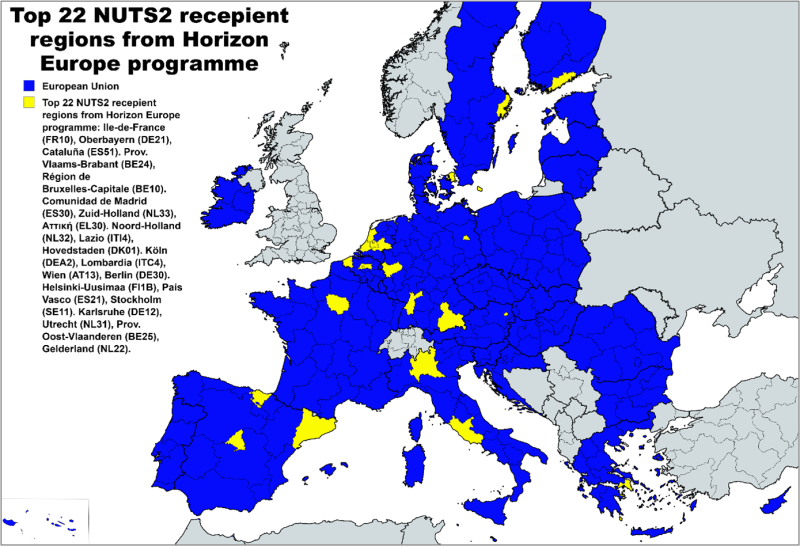
Source: own coloring with MapChart.net
This concentration is driven by structural factors: institutional capacity, international consortium networks, the ability to pre-finance projects, and the so-called excellence-based selection principle, which does not take into account differences in initial levels of development. The system thus generates a self-reinforcing dynamic: successful regions attract further resources, thereby further strengthening their competitive advantage.
All this becomes particularly problematic in light of preparations for the 2028–2034 Multiannual Financial Framework (MFF). The new Competitiveness Fund outlined by the European Commission would integrate a substantial share of research, innovation, digitalisation and strategic industrial policy instruments, potentially accounting for around one third of the EU budget. At the same time, the territorial dimension of cohesion policy – that is, the classic regional policy providing differentiated allocations based on development indicators – appears set to shrink significantly after 2028. Region-specific allocations may give way to thematic, integration-driven and competitiveness-oriented objectives.
If extreme concentration is already evident within direct programmes, while the weight of cohesion instruments designed to ensure balance is declining, regional disparities will not merely persist but become institutionalised. The new structure risks weakening precisely those mechanisms that have, even if imperfectly, counterbalanced market forces and agglomeration effects.
The primary solution, therefore, would be to preserve the core principles and mechanisms of traditional regional policy. For decades, cohesion policy consciously applied differentiated support intensities linked to development categories, multiannual partnership programming and territorially based allocations. This logic was not opposed to competitiveness; rather, it was its precondition. By promoting convergence, it expanded the effective functioning space of the Single Market.
Only thereafter – and not as a substitute – should a change of approach be introduced into direct programmes. If the Competitiveness Fund remains a dominant pillar of the next budgetary cycle, the core principles of regional policy must be embedded in its selection and evaluation criteria. Without capacity-building components, territorial balancing mechanisms and differentiated assessment, current concentration trends will only deepen.
Competitiveness does not arise from the preservation of regional disparities. On the contrary, sustainable European competitiveness presupposes the reduction of territorial inequalities. It is not possible to build European-scale economic strength by allocating resources primarily to the over-financing of already leading regions. An internal market in which growth potential is confined to a handful of centres will, in the long run, be neither balanced nor politically sustainable. The Union’s next budgetary cycle is therefore not merely a financial decision, but a strategic choice about whether reducing regional disparities remains a foundational principle of European integration.
Authors are the experts of the Hungarian Development Promotion Office (https://mfoi.org/en/), which is aiming to increase the Hungarian participation in EU programmes under direct management.

By Dr Bernadett Petri, Managing Director of MFOI Advisory
Original article on Euractiv website: Disparity vs. Cohesion: 1-0 | Euractiv