Hungary has just another year and a half to prepare for the sweeping
transformation of the EU funding system expected from 2028 onwards, while
the gap between Hungarian businesses and their European counterparts in
accessing direct EU funding can now often be measured in years rather than
months, Bernadett Petri said.
According to the Managing Director of the Hungarian Development
Promotion Office (MFOI), however, the EU’s new 2028–2034 budget
framework could be more favourable to Hungary in several respects:
industrial development could receive greater emphasis, the application
procedures could be simplified, and so-called cascade funding, distributed
through intermediaries, could open up significant entry opportunities for
Hungarian companies to access EU funding.
At the same time, the expected release of EUR 4.2 billion in cohesion funding
is, in her view, a double-edged developement. While it could provide a boost
to the economy, it could once again divert businesses’ attention from direct
EU funding opportunities.
The anticipated lifting of restrictions on institutions that have underwent a
change of operating model could represent a major breakthrough, but
regaining the consortium positions lost in recent years will be a lengthy
process.
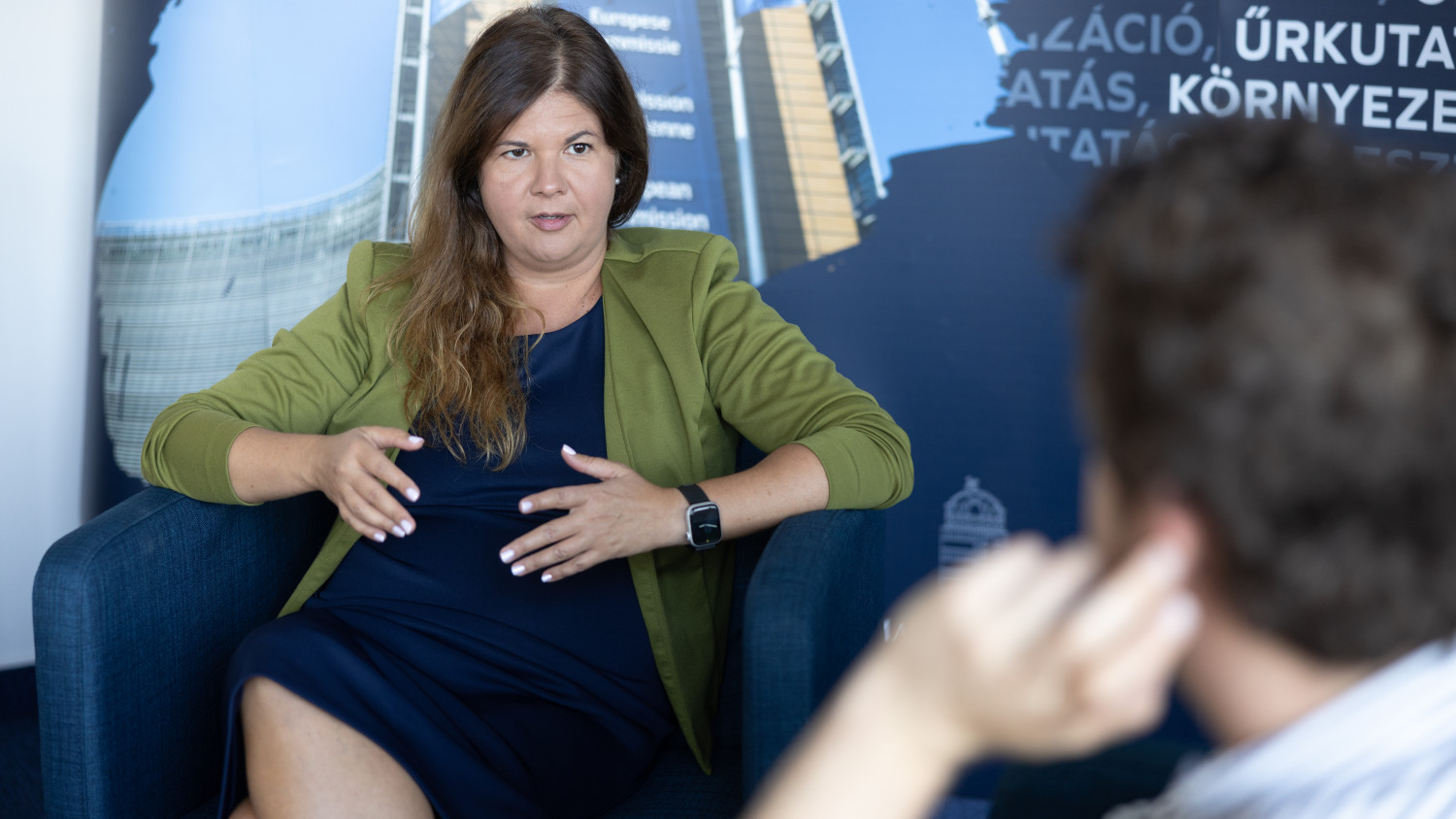
These were among the issues discussed by Bernadett Petri in an interview
with Portfolio, alongside the new European Competitiveness Fund, the
preparedness of Hungarian SMEs, and the new logic governing EU funding
after 2028.
Portfolio: We recently reported that, looking only at nominal amounts,
Hungary received less direct EU funding in 2025 than in the previous year,
although its share of total funding improved. What is the actual situation?
Bernadett Petri: The picture is indeed not quite as straightforward as it might
seem. The funding system works in such a way that Hungary’s performance
improves significantly in some programmes, while stagnating or deteriorating in
others. Horizon, for example, is a programme in which our share has been
declining more or less continuously since Hungary joined the EU in 2004.
Numerous government measures have been introduced to reverse this trend,
yet it continues to decline.
Nevertheless, the figures published earlier do show a certain proportional
improvement in the direct funding coming to Hungary.
This is primarily due to our particularly strong performance in certain
programmes, such as LIFE and the Citizens, Equality, Rights and Values
programme. There has also been an improving trend in various business
support programmes, including opportunities for SMEs under the Single Market
Programme.
But my main message on this issue remains the same: it is clear that we still
have a great deal of work to do.
Portfolio: What opportunities do Hungarian SMEs and larger companies still
have to participate? We are already at the end of 2026, and the current
financial programming period ends in 2027.
Bernadett Petri: Funding envelopes are indeed running out in some areas, but
this can sometimes create new opportunities. Where money has not been fully
spent and there is a desire to avoid a reduction in the amount allocated to that
particular objective in the next period, simplified cascade funding calls may be
launched to ensure that the available resources are used.
Moreover, a new programme is being launched now. This is highly unusual in
EU practice, as launching an entirely new programme in the final year is not
something that normally happens. The AGILE programme, with a budget of
approximately EUR 115 million, is specifically intended to help SMEs, start-ups
and emerging defence technology players bring their developments to military
end-users more quickly. The European Commission is expected to support 20–
30 projects, in some cases covering up to 100% of eligible costs.
I therefore believe it is worth applying for funding in late 2026 and throughout
2027. These will certainly be the final opportunities under the current
structure. From 2028 onwards, the system will change significantly.
The so-called third-party cascade financing arrangements I mentioned earlier
are also very interesting. They work as follows: the EU allocates a larger sum to
a consortium for specific objectives and then tells it to distribute the money
further. This redistribution generally takes place through a simplified procedure.
Portfolio: In other words, a Hungarian SME does not necessarily have to
submit a large, complicated application directly to Brussels.
Bernadett Petri: Exactly. There will be many attractive opportunities of this kind
in 2027. Numerous smaller initiatives are expected, ranging from manufacturing
and production optimisation to the cultural and creative sectors. These
arrangements are also an excellent entry point into the world of direct EU
funding.
And we are not talking only about grants of a few tens of thousands of euros:
under certain schemes, as much as EUR 200,000–300,000 may be available for
technological development.
Calls are already available in areas such as robotics, cybersecurity, hydrogen
technology, industrial digitalisation, and defence and dual-use solutions. In
2027, we expect further growth in these opportunities, particularly in artificial
intelligence, deep tech, healthcare-related industries and defence innovation.
Portfolio: How well prepared are Hungarian businesses for this? Accessing
direct funding often requires a completely different approach from applying
for traditional cohesion funding.
Bernadett Petri: If we look at how the system has evolved, funding under
operational programmes—when calls are available at all—is relatively
straightforward to apply for. I would not necessarily say that managing these
projects is always easy, either. In fact, in several cases, managing direct EUfunded projects is simpler.
For example, there are so-called lump-sum arrangements, under which funding
is accounted for on a flat-rate basis. For a Hungarian company or local authority,
it can sometimes seem almost unbelievable that something can genuinely be
accounted for so simply.
The application process itself is obviously more difficult, however. Cascade
financing lies somewhere between the two: traditional cohesion funding on the
one hand, and large-scale international consortium applications on the other.
Our experience is that this can be the first step for organisations that have not
yet participated in larger projects involving substantial funding and serious
cooperation arrangements. The next step may be joining a consortium,
followed, perhaps a year or two later, by taking on the role of consortium
leader.
Portfolio: At MFOI, what have you learned about explaining to a Hungarian
business that joining a consortium can be worthwhile even when the benefits
cannot immediately be expressed as a monetary amount?
Bernadett Petri: It is very difficult. And I think this question provides an
excellent context for our entire conversation.
As I was preparing for this interview, I was thinking about the main message I
wanted to convey. I believe it is this: looking at everything expected to change
in EU funding from 2028 onwards, we are at the last possible moment to learn
how this world works.
Our job, therefore—and early next year I will have been leading this
organisation for four years—is essentially to evangelise. We need to convince
companies, civil society organisations and certain public institutions that are
familiar with local or national funding that this is a good thing. Research
institutes are somewhat easier to persuade in this respect.
This remains an enormous challenge.
Portfolio: What are Hungarian companies missing most?
Bernadett Petri: Above all, they lack the capacity to adapt to this shift easily.
Focusing on businesses, they need at least some understanding of the direction
in which EU policy is moving. They need to think strategically and over the
longer term. And, obviously, they need to know English; in this environment,
that is indispensable.
They also need to understand something a little more abstract: if I am a
Hungarian SME engaged in manufacturing, how can I integrate what I produce
at home into a European ecosystem? How can I develop my business in a way
that may subsequently create opportunities for me to gain access to new
markets?
On the one hand, accessing direct funding means receiving money to spend on
a particular objective. The peculiar thing is that, by the end, the money is no
longer sitting in your pocket, because you have carried out what you committed
to doing. This is often alien to the Hungarian way of thinking.
On the other hand, in most cases, such projects do not result in the
construction of major infrastructure, although this could change significantly
from 2028 onwards.
The third issue is the need to work with foreign partners. Their accounting
systems and approaches differ from ours; they think about individual tasks
differently and organise their time differently. For Hungarian businesses, this
can often come as a cultural shock. Our training programmes repeatedly show
that these skills also need to be developed.
Portfolio: Could these differences in knowledge and attitudes explain why
Hungary still secures only roughly half of the direct EU funding one might
expect based on its share of the EU population? We often hear that the
system favours Western European participants, but it also seems that
Hungarian businesses are sometimes reluctant to take the plunge. Have you
noticed any change?
Bernadett Petri: In the areas where we have worked very actively, I believe we
have managed to make progress in the right direction. More applications
submitted mean more successful applications. It is as simple as that.
Businesses have also become more open to learning about this world in the
first place. I cannot say that they do not know much more about it today than
when we began this work. Many now actively search the internet and use
artificial intelligence to generate lists of funding calls that might be suitable for
them. Sometimes, this produces some rather interesting solutions.
They then come to us, and, naturally, many drop out during project
development. But I believe that, too, is part of the learning process.
Portfolio: Now, however, the prospect of “easier money” has reappeared on
the horizon: the European Commission has proposed releasing EUR 4.2 billion
in cohesion funding previously suspended for Hungary. What effect will this
have on interest in direct EU funding?
Bernadett Petri: On this issue, one of my eyes is crying while the other is
laughing.
On the one hand, releasing the funds and making them available to the
economy is obviously a good thing. On the other hand, it once again
encourages the perception that easy money has arrived. Businesses may say:
“Fine, I will obtain this funding instead. It is enough for me for now, and I can
use it to plug the gaps.”
In reality, neither direct EU funding nor operational programmes are intended
for that purpose. But the mindset persists nonetheless.
We have seen this before: whenever a major wave of domestic funding calls
appeared, interest in direct EU funding available in the same area tended to
decline to some extent. That is why one of my eyes is crying.
Portfolio: And why is the other one laughing?
Bernadett Petri: Because the expected lifting of the restrictions affecting
institutions that underwent a change of operating model would be an
enormous development.
There have also been numerous misunderstandings in both directions. One
misconception is that everyone from Hungary has been excluded from Horizon.
Virtually none of that is true. Not everyone was excluded, and the restrictions
did not concern Horizon alone.
The restrictions affected institutions that had undergone a change of operating
model. They meant that these institutions could not act as beneficiaries in
certain direct EU-funded projects; in other words, commitments could not be
made to them and contracts could not be concluded with them.
What is happening now is that, if the restrictions are lifted, these institutions
will once again be able to receive funding.
Portfolio: So, if a Hungarian university that underwent a change of operating
model wants to join a Horizon, LIFE or even European Defence Fund project
now, would it be worth including it in a consortium?
Bernadett Petri: Yes, and we have a client in precisely this situation. It is now
entirely realistic to launch an application on the assumption that, by the time it
is assessed, the restrictions will probably no longer be in force.
(The Council of the European Union’s General Affairs Council is expected to lift
the ban at its October meeting—editor’s note.)
There was another, less visible consequence, too: many people abroad came to
believe that everyone from Hungary was excluded.
The reaction was sometimes: “We would like to apply with Hungarian partners,
but aren’t they excluded?” This had a chilling effect on the entire Hungarian
university and research institute sector. We constantly had to explain that not
everyone was affected. We ourselves repeatedly experienced situations in
which a foreign partner ultimately said they would rather apply with someone
else after all.
Portfolio: Essentially, we were placed in quarantine.
Bernadett Petri: Exactly. And even if the restrictions are lifted, their full impact
will not disappear overnight.
In the meantime, consortia have been formed for applications launched
without us, and the roles that Hungarian participants might have filled
geographically or professionally have been assigned to someone else. It will
take time before we regain those positions.
We must work on this as well: we need to reconnect with these partners and
demonstrate that Hungarian participants remain valuable partners in funding
applications. We need to regain our places in these partnerships; otherwise, the
effects of the current situation could remain with us for years.
Portfolio: I also see two misconceptions among companies regarding the
release of the EUR 4.2 billion. The first is that many interpret the news as
meaning that the EU funding system is only now becoming accessible to
them, even though a substantial proportion of them could already apply for
this money, since most of the relevant expenditure had been pre-financed
without waiting for EU reimbursement.
The second misconception is that companies immediately ask: when will new
calls funded from this amount be published?
Bernadett Petri: That is true. Although a substantial part of this is a budgetary
and financing issue, there are also specific calls whose launch genuinely
depends on whether these funds become available. There are examples of such
schemes in the digital sector.
But the key point is that we should not imagine that EUR 4.2 billion worth of
entirely new funding calls will suddenly appear.
Portfolio: You have mentioned 2028 several times as a genuine watershed.
Under the new seven-year EU budget framework, we will need to master two
different approaches simultaneously: performance- and milestone-based
funding, familiar from the Recovery and Resilience Facility, and the
application system for centrally managed direct funding. Hungary has partly
missed out on both in recent years. How serious a disadvantage is this?
Bernadett Petri: Let me take a step back, because I think we first need to
understand the changes expected after 2028. We have studied the structure of
the new Multiannual Financial Framework (MFF), the draft regulations and the
system as a whole in considerable depth. What we see is that this will represent
a major shift.
The milestone-based approach is clearly not going to remain confined to the
Recovery and Resilience Facility (RRF). It is also being introduced into what we
previously called cohesion policy, which under the new system will be organised
much more around National and Regional Partnership Plans.
This represents a completely different way of thinking. Various objectives will
have to be achieved and reforms implemented, and the availability of funding
will be tied to these results. Under cohesion policy, we have become
accustomed to financing various developments and then seeing whether they
deliver the intended results. The new system will involve much stricter
conditions and selection criteria.
Essentially, this brings the logic of national programmes closer to that of direct
funding.
Portfolio: What is the first lesson Hungary needs to learn?
Bernadett Petri: At the project management level, we need to learn how to
work with performance-based financing and performance assessment. We
need good indicators, which in turn require substantial project management
expertise.
I am not sure the current domestic professional community is fully equipped to
meet this need. Quite the contrary.
The second lesson is that national plans will have to be coordinated with the
areas from which we intend to obtain direct funding. We need to establish
synergies between these two instruments that we have largely failed to create
over the past fifteen years.
This is an enormous task. It requires a great deal of data, an in-depth
understanding of local conditions and detailed knowledge of the economy. The
national plans will have to propose numerous measures whose actual
implementation or financing will ultimately take place through direct funding.
The two can no longer be clearly separated.
Portfolio: The third change may be even more tangible for businesses: after
2028, direct EU funding will be much more capable of financing actual
industrial development projects.
Bernadett Petri: That is right. And as the EU increasingly shifts towards funding
with an industrial policy orientation, direct EU funding could also cover factory
technologies, infrastructure expansions and specific development projects.
This was previously quite alien to the world of direct funding.
There have been attempts, of course. We have received numerous enquiries
from organisations that need infrastructure and have had to squeeze it into
their projects through all sorts of workarounds. For example, a model factory
was established where certain technologies could be tested and their
performance measured. The infrastructure itself was essentially created as a byproduct.
Other countries have been much more resourceful in this respect. I know of an
example from Spain where entire sections of streets were paved with materials
featuring different properties, after which characteristics such as thermal
conductivity were examined. This kind of ingenuity has been less evident in
Hungary.
After 2028, however, we will need to reckon with the possibility that decisions
on certain infrastructure developments—particularly those linked to EU
objectives such as clean energy—will be made in Brussels rather than at home.
This also means that we will need to engage much more closely with the
decision-making process there and develop a much better understanding of the
criteria on which those decisions are based.
Portfolio: Meanwhile, the European Competitiveness Fund (ECF) is being
established, bringing several programmes that currently operate separately
into a single system. Will this make things simpler?
Bernadett Petri: In certain respects, yes, but it will also create new problems.
Take the Digital Europe Programme, for example. We act as its national contact
point, so we have a close view of the situation. The EU is currently finding it
very difficult to spend the money allocated to this area, while setting an
extremely high technological bar for the solutions it wants to support.
In digitalisation, there is currently a basic level of funding that can be covered,
for example, through operational programmes. At the other end of the
spectrum are highly advanced, cutting-edge digital technologies. But there is a
gap between the two, and there is no real funding instrument to address it.
The ECF’s “digital leadership” window will include a wide range of solutions, not
just grants. It will combine venture capital, various market-based instruments,
loans and grants.
I believe this approach is quite alien to the way things are understood in
Hungary.
Portfolio: Moreover, if the technological entry threshold is set very high at the
same time, this could be particularly difficult for companies in Central and
Eastern Europe.
Bernadett Petri: Exactly, and this raises many questions about whom the
programme is actually intended to benefit. We may need to consider what
other instruments could be used to fill this intermediate funding gap. We will
also need to argue our case skilfully in European negotiations to ensure that the
calls can be applied to the economic realities of Central and Eastern Europe.
We are not very successful with innovation funding applications anyway.
Portfolio: The changes planned for Horizon from 2028 onwards, however,
could bring a favourable shift by giving greater weight to applied research and
commercial exploitation.
Bernadett Petri: Absolutely! In the past, there were some very far-reaching funding calls that
supported basic research up to a certain point but failed to turn it into
industrial value.
This has been a problem at European level for decades. We generate enormous
amounts of innovation and intellectual property, but then struggle to apply the
results and scale them up.
If EU funding genuinely moves in this direction, I believe it could be a very
positive change. The research and development system will, of course, have to
adapt accordingly.
Portfolio: Another particularly interesting element of the ECF from Hungary’s
perspective is the financing of project preparation and the greater influence
member states will have over programme priorities.
Bernadett Petri: I think this is one of the most interesting aspects of the plans.
Under the ECF Project Advisory component, there will be opportunities to
finance project preparation, and member states will have a greater role in
shaping priorities and work programmes. This is an enormous opportunity.
We believe that we need to engage in this work through networks and
partnerships, and we need to start now, because there will be intense
competition over how member states can position their own economic actors
to benefit.
We are already doing this work continuously, so perhaps it is easier for us to
imagine how these project preparation and advisory opportunities could be
used in Hungary.
Interestingly, three years ago, when we discussed this with the relevant
European Commission directorate-general, we essentially asked for precisely
this kind of opportunity. At that time, it was not yet clear how it could fit into
the system. Now it appears that there will be a dedicated funding allocation
and a legal framework for it.
Another major advantage could be that work programmes will be less ad hoc
than the calls we have today.
Portfolio: For this to work, however, Hungary must first have a clear
understanding of what it wants.
Bernadett Petri: We need a thorough understanding of our own strategic
challenges. What do we want funding for? Where should money be invested?
What type of financing do we need?
I believe the entire country needs to be mapped from this perspective. This
knowledge must then be brought into the European decision-making system.
If we combine this with the project preparation and advisory opportunities, we
could significantly improve Hungary’s ability to secure direct EU funding.
What I also feel is missing is a capacity-building system for businesses that
could use something like an SME readiness indicator to show how well
equipped an individual company is to access these funds. Such a system would
also help identify where intervention is needed from an economic development
perspective.
Because, from this point onwards, I believe this is fundamentally a matter of
economic development.
Portfolio: Could the fact that MFOI is already operating in Hungary give us a
competitive advantage? From what I have seen, roughly half of EU member
states do not have a dedicated state agency specifically tasked with helping
applicants access direct funding.
Bernadett Petri: I believe such an organisation is indispensable. And finally, we
are in a position where we started doing something years before it became
necessary, rather than having to chase organisations that have already been
doing it for ten years.
MFOI has numerous partnerships with similar organisations in other member
states. In ten or eleven countries, it is not even possible to identify clearly who
performs this function.
In Hungary, by contrast, our mandate is clear: we work directly with clients. We
do not merely think about direct funding at a strategic level; we sit down with
businesses and other applicants and help develop their projects.
I believe this could give us a significant first-mover advantage.
The question will be how we can connect this work with economic
development and build the necessary capacity among SMEs by 2028. We really
have only about a year and a half.
Portfolio: Under the new competitiveness framework, major projects serving
the common European interest—known in Brussels as Important Projects of
Common European Interest (IPCEIs)—will once again become more
important. Historically, countries in our region have not always fared well in
these projects, because wealthier Western and Northern European member
states have stronger connections and greater lobbying power. How can
Hungary establish its position in these projects before the next budget period
begins?
Bernadett Petri: First, we need to understand the European relevance of the
economic activities carried out in Hungary.
Often, we ourselves do not fully understand this, and neither do the businesses
carrying out those activities.
For every project, we have to do research to determine how that particular
piece of the puzzle fits into the broader European picture. It is by no means
self-evident.
After that, we need to establish contact with potential competitors at a very
early stage, surprising as that may sound.
Large Western European consortia continuously monitor the market and
actively seek opportunities to apply for funding alongside their competitors.
They get to know them, learn from their expertise and, at the same time, try to
bring them onto their side.
This is a model that works.
In Hungary, by contrast, we are often either afraid of our competitors or simply
do not know who they are.
Portfolio: IRIS² and the AI Gigafactory are good examples. Hungary is
participating in these major European projects using EU funding, yet some
Hungarian businesses seem unaware that this could give them access to
opportunities or allow them to participate. If companies do not even receive
this kind of basic information, we are not starting from zero but from minus
fifty.
Bernadett Petri: The period beginning in 2028 will undoubtedly be difficult.
At the same time, I believe the ECF structure could, overall, be more favourable
to us than the current system. At least there will be a more unified application
system, rather than dozens of schemes operating according to different
principles and with varying levels of difficulty.
It is also expected to be faster. We recently calculated that, for innovation calls,
as much as two years can pass between the publication of a call and the signing
of a grant agreement. After two years, however, an innovation may no longer
be innovative.
The management of European Digital Innovation Hubs (EDIHs) is another good
example of how we sometimes fail to take advantage of opportunities that
already exist.
In Hungary, managing EDIHs can sometimes feel like an unwanted burden. The
priority is to meet the key performance indicators (KPIs) quickly, after which
organisations have to go looking for businesses to which they can explain what
the whole initiative is about.
Yet the actual purpose of EDIHs is to improve businesses’ digital capabilities,
which involves much more than technological solutions alone.
Each EDIH is also connected to EDIHs in all the other countries. This is
essentially one of the simplest international forums for finding partners.
I can do little more than keep repeating that businesses need to get involved.
From an economic development perspective, some form of incentive may also
be necessary. We could offer a benefit to a business willing to participate in
such a programme, or make access to domestic subsidies or other economic
development instruments partly conditional on whether the company has
already taken advantage of these opportunities.
Because businesses may not do so of their own accord.
Portfolio: Yet Hungarian experience shows precisely that once a company has
joined one of these European networks, it can subsequently progress to more
advanced consortium projects.
Bernadettt Petri: Absolutely. We participate in several such collaborations, and
new initiatives in the agricultural sector are also getting under way.
Nevertheless, I constantly find that we have to seek out companies and SMEs
and persuade them to participate.
I believe awareness-raising should begin with Hungarian businesses
understanding that, when the situation changes in 2028, the financial
environment will no longer be the one they have grown accustomed to.
The market will remain, as will the new types of EU instruments. Businesses
cannot assume that there will always be a national subsidy or another
mechanism to step in and give their development projects a push.
Portfolio: Are there any other areas in which Hungarian companies are
particularly disadvantaged by their lack of preparedness?
Bernadett Petri: Intellectual property rights are certainly one such area.
The exploitation of technological solutions and the management of different
forms of intellectual property protection are still at a very early stage in
Hungary. Sometimes, unresolved IP-related issues directly prevent a company
from applying for funding.
This is another area where training or other economic development
instruments could help.
We have been cooperating for a long time with the National Association of
Entrepreneurs and Employers (VOSZ) and the Hungarian Chamber of Commerce
and Industry (MKIK). Perhaps we will need to make this cooperation even more
effective and institutionalised in the future.
Portfolio: Could it also be a problem that the names of the programmes
themselves put businesses off? A Hungarian agricultural company, for
example, might easily assume that a programme called “digital innovation”
has nothing to do with it.
Bernadett Petri: Certainly. The difficulty is that the European Commission
requires us to use these names, so changing them is not easy.
We somehow need to break down these barriers. I see the same thing when we
start talking about policy or what is happening in the European Union. Many
people immediately switch off, thinking: “I do not need to pay attention to this
because I manufacture products here at home.”
But that is simply not the case at all.
Portfolio: Which “ordinary” Hungarian SME should already be considering
applying for direct EU funding? Many probably imagine that this requires an
extraordinary, world-class high-tech innovation. Yet perhaps a company
producing sustainable thatched roofing with better insulation properties
could also qualify.
Bernadett Petri: Joking aside, we have had thatching companies come to us
several times.
Essentially, businesses from every sector have approached us.
I believe we need to pursue this issue on two parallel tracks.
Large companies should submit far more applications than they do today. They
should also consider seeking a role as an intermediary distributing cascade
funding, potentially in cooperation with the government.
I see this as a major opportunity for Hungary to break through.
Portfolio: In other words, rather than having only Hungarian companies apply
for smaller amounts, we should also have a Hungarian organisation that
distributes a large EU funding allocation itself?
Bernadett Petri: Exactly. A major Hungarian player should emerge as a cascade
funding intermediary. A consortium led by that organisation could receive an
allocation of tens or even hundreds of millions of euros and use it to finance
smaller participants.
I believe we should find a way to lobby the European Commission for this. We
could even explore a hybrid arrangement involving both a large company and
the government.
This would not mean that we could distribute the money domestically however
we pleased. These are highly regulated arrangements under which funding can
be provided only for specified purposes. The application system also operates
under EU rules, making favouritism impossible.
Nevertheless, we could at least tailor the arrangements to some extent to
Hungary’s domestic circumstances.
Portfolio: What is the second track?
Bernadett Petri: Showcasing successful Hungarian SMEs.
We can find such companies across a wide range of projects. We have already
mentioned LIFE. Under that programme, it is not always necessary to come up
with an extraordinarily innovative solution.
LIFE also supports replication projects, which involve transferring a solution that
has already received EU funding to another setting. Moreover, an international
consortium is not always required; in some cases, cooperation among domestic
participants is sufficient.
Hungary actually performs better in these calls than in many other
programmes.
We should showcase the SMEs that have succeeded in these schemes so that
other businesses can see that there is an established path to follow.
I am still looking, however, for a company that believes its own solution is
innovative, while we tell it that it is not particularly innovative, and which then
nevertheless manages to secure EU innovation funding for it. Our experience is
that when, during project development, we conclude that something is not
genuinely innovative, it usually turns out that it is not. We cannot find a partner
for it, and we cannot make it work elsewhere either.
Portfolio: But this is precisely something that could change in 2028, if
industrial policy and the application of existing technologies receive greater
emphasis instead of innovation excellence.
Bernadett Petri: That seems almost certain. The bar for the degree of
innovation required is unlikely to be set as high as it was in the previous period.
The EU will not be seeking to finance only research and innovation excellence;
it will also support industrial policy solutions.
This could be another change that works in our favour.
Portfolio: After all, Europe has already generated enormous amounts of
intellectual property and innovation. Our problem is that we fail to apply
these results and scale them up. EU patents often end up being exploited in
the United States.
Bernadett Petri: This is where Europe is weak.
Portfolio: How poorly does Hungary perform in this respect?
Bernadett Petri: According to the European Innovation Scoreboard, Hungary
belongs to the group of moderate innovators. Some of the indicators
specifically measure the application and commercial exploitation of innovation,
and we perform very poorly on these.
From this perspective, even a relatively modest change in funding priorities
could make a major difference for us if, in the future, funding were no longer
restricted to projects operating at the very highest level of innovation.
Portfolio: While everyone is waiting for the EUR 4.2 billion in cohesion
funding, how can we make the case that direct EU funding is also available?
Bernadett Petri: I believe there are three ways.
The first is preparing for 2028. We need to communicate, in the simplest
possible terms, that the old funding system will no longer be available in the
same way. New types of EU funding are coming, and businesses need to start
learning how to access them now. We still have approximately a year and a half.
The second is the opportunity to access funds being disbursed rapidly at the
end of the current programming period. In 2027, businesses will still be able to
take advantage of calls through which direct funding can be obtained under
simplified procedures.
The third is that, by the end of a seven-year financial period, it becomes much
easier to see where Europe’s major consortia are, what partnerships have
emerged and how a particular sector has evolved over the preceding seven
years.
We have mapped this landscape quite thoroughly. The next year and a half
could therefore also be an opportunity for Hungarian businesses to expand
their commercial networks. They should consider where they need to invest
money, time and energy, and whom they should build relationships with, so
that they already have potential consortium partners in place after 2028.
Portfolio: Is it still common for a company to approach MFOI just one week
before an application deadline, saying that it has found a Horizon or another
EU funding call and asking us to put an application together quickly?
Bernadett Petri: Unfortunately, yes, and this is a habit that should have been
abandoned a long time ago.
The fact is that I believe consortia for projects to be funded through the ECF
from 2028 onwards have already begun forming elsewhere in Europe.
Hungary’s disadvantage can therefore often be measured in years rather than
months.
At least at MFOI, we are now in a position to help address this. We have the
expertise needed to understand how this world operates in Hungary, and we
intend to use that knowledge to change the situation.
Dániel Szabó
Image source: Balázs Vida